Saturday, August 14, 2021

Famous People Who Possibly Never Existed

In our present age of instant information sources (both real and fake), it's easy to search for the biography of a well-known person. However, it was not always this way. The facts about many historical figures weren't written down until years, sometimes decades or even centuries, after they allegedly lived. With these large gaps of time, any evidence of the person's actual existence may be nothing more than stories with an absence of any real proof.

Here is a list of famous people whose names you will recognize but who may never have existed at all, at least not in their popular and commonly accepted form. This list of 6 is only a small number of famous people who may or may not be real. The original list I came across listed 17 people.

Mulan

The tale of a woman dressing as a man and fighting for a cause (whether family, country, or religion) is a timeless theme (think Joan of Arc). Some come with proof to prove they are real and others don't have the necessary credentials of proof. Disney introduced movie fans to the legend of Mulan, though she was already famous in Chinese literature. It's commonly accepted that Mulan was a real person who actually did this. But any evidence of this actually happening is scarce.

The book Chinese Shadow Theatre: History, Popular Religion, and Women Warriors says Mulan might have been a fictional character based in part on Wei Huahu, an actual female warrior from ancient China. As for Mulan herself, the earliest known reference was in an ancient song, The Battle of Mulan. But it doesn't specify when she lived, gives few details of the actual battles she fought, and didn't give a full name for her other than Mulan.

Then there's a text called Lienü zhuan translated as Exemplary Women of Early China, written by Liu Xiang around 18 BC, and packed with over 120 biographies of famous women from ancient China. Despite supposedly being a prominent person, Mulan is not listed. Even though she supposedly lived several hundred years after Xiang first published his book, there's a section at the end for supplemental biographies. No one has ever added Mulan, even though her alleged exploits were quite exceptional.

Shakespeare

Surely the great William Shakespeare was a real person. He has lots of writings and there are portraits of him. So, how could he not be real? I'm been to Stratford-Upon-Avon in England and have seen the house said to be his. Surprisingly, many people are convinced that "William Shakespeare" was a pen name, and whoever wrote those stories might be lost to history.

As presented on PBS, there was a man named William Shakespeare, but we know little about him. We don't know where he learned to write, how he learned so much about law, politics, and history, and his will mentioned no plays or sonnets, which you'd think would be foremost on his mind. It sounds like the real Shakespeare didn't write much more than the daily to do list. If true, then who is the real Shakespeare? Plenty of candidates have emerged over the years, like Francis Bacon, Ben Johnson, and Christopher Marlowe, but these possibilities haven't stuck.

There's another legitimate possibility in Edward de Vere—the Earl of Oxford. According to J. Thomas Looney, a schoolteacher who uncovered a great deal about the man, Vere wrote poetry that reads much like what is attributed to Shakespeare. According to this theory, Vere used an assumed name because being one of the nobility he didn't want to be associated with a low-brow art like playwriting. Then, when he died, his followers published his plays under the pen name of some random commoner named William Shakespeare who had died years before.

Robin Hood

The legendary English folk hero, Robin Hood, is well-known for robbing from the rich and giving to the poor, residing in Sherwood Forest with his band of merry men, and wooing Maid Marian. The stories are certainly fictitious, but was Robin Hood a real person or simply based on one? It's impossible to say if any one individual inspired the legend's creation. The stories are either totally invented, or are a combination of elements taken from different historical sources.

Identifying a single person as the basis for the famous outlaw becomes even more difficult as the stories began to grow in popularity in the 13th and 14th centuries. Various English outlaws began calling themselves Robin Hood. Nevertheless, some historians speculate that Robin Hood was based at least in part on nobleman Fulk FitzWarin, who rebelled against King John (one of Robin Hood's foes). FitzWarin's life was later turned into its own medieval tale, Fouke le Fitz Waryn, which holds some similarities to the Robin Hood stories. If he was the basis, then a name change was a good decision. The name Fulk FitzWarin doesn't exactly strike fear into the hearts of villains.
William Tell

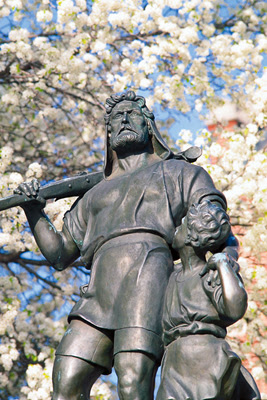
William Tell is a Swiss folk hero who allegedly lived in Switzerland during the early 14th century, when the Hapsburg dynasty of Austria ruled the land. As the story goes, an Austrian official placed a hat on a pole in the city of Altdorf and commanded every Swiss subject to remove their caps in a show of respect as they passed by it. One day, William Tell, a local peasant accompanied by his son, refused to comply. In response, the Austrians forced him to shoot an apple off his son's head at 120 paces or face execution. Tell loaded his crossbow and skillfully shot the apple. He then went on to lead a small revolt against the Austrians.

Tell is essentially the Swiss version of Robin Hood and, much like the outlaw of Sherwood Forest, he probably never existed. The apple story is extremely similar to a Viking folktale, which most likely was imported to Switzerland at some point and used by Swiss patriots as a rallying cry against their Austrian rulers.

Homer

Homer is the Greek poet who wrote two of the books that your English teacher probably required you to read in high school—The Iliad and The Odyssey. Despite the popularity and importance of these mythological epics, their author remains shrouded in mystery. Homer almost certainly was not the creator of these tales, which likely preceded him by about 1,000 years. He was simply the first to write them down. As for the poet himself, some say Homer was blind, while at least one author argues that Homer was actually a woman.

Some historians believe that Homer was not a single person, but rather a group of Greek scholars. In the end, we will probably never know the answer, but the legacy of Homer's works will continue.

King Arthur

We're all familiar with the Arthurian legend. Even if you haven't read the stories, you likely saw Monty Python and the Holy Grail or are familiar with the theatrical production and subsequent movie, Camelot. In any case, the British king is said to have claimed the sword, Excalibur, from the Lady of the Lake and found the aforementioned Holy Grail. These stories are most likely a mishmash of folklore, but was the Arthur of legend based on a real man? The first tales of Arthur appeared in the ninth century and chronicle his battle against the invading Saxon armies, so it's likely that the individuals who served as the basis for Arthur lived sometime before then. Some historians suggest the Roman military commander Lucius Artorius Castus as a possible candidate. Others suggest Riothamus, king of the Britons during the fifth century.

John Henry

John Henry—the steel-driving man has been immortalized in folk music since the 1800s. His Ballad of John Henry tells the story of an ex-slave working on the railroad. He challenged a steam drill to see which could work faster, and he won. He died soon afterwards from sheer exhaustion. The greatest heroes die in the end, and Henry's story has ascended to near-myth because of it.

Thing is, he might actually be a myth. As NPR explains, John Henry is almost certainly a "tall tale," though one based on "historical circumstance." There were obviously men working on railroads back in the 1800s, and steam drills were eventually introduced as a way to speed up labor and reduce costs. More than likely, the rail workers disapproved of a machine taking their jobs, though it's unproven if anybody actually attempted to work faster than one.

Saturday, August 7, 2021

It's Friday the 13th —Does it make you stop and think?

Triskaidekaphobia:  Fear of the number thirteen.

Paraskevidekatriaphobia:  Fear of Friday the 13th.

An obviously irrational concept that a mere number can bring bad luck to someone.  Or that a specific day of the week can be unlucky.  But that doesn't stop us from dwelling on the possibility.

This coming Friday is Friday the 13th.  The tradition of Friday being a day of bad luck dates back centuries with some of the more common theories linking it to significant events in the Bible believed to have taken place on Friday such as the Crucifixion of Christ, Eve offering Adam the apple in the Garden of Eden, the beginning of the great flood.

Many sources for the superstition surrounding the number thirteen and its association with bad luck also derive from Christianity with the Last Supper being cited as the origin.  Judas was the thirteenth person to be seated at the table.

And when you put the two bad luck symbols together you get Friday the 13th—the day associated with misfortune.

One legend of the origin of Friday the 13th as unlucky comes from the persecution of the Knights Templar. Philip IV of France borrowed enormous sums of money from the very wealthy Templars to finance a war with England. An ineffectual king and an even worse military commander, Philip was easily defeated. He saw a way of both currying favor with the Pope and eliminating his huge debt. On that fateful day of Friday, October 13, 1307, he ordered all Templars arrested and their property seized. Jacques DeMolay, the Grandmaster of the order, was thrown in prison along with several other high-ranking members of the order. The Knights Templar, which had dominated medieval life for two centuries, were no more. Unfortunately for Philip, the Templars had learned of his planned treachery before hand. Many of them escaped and their vast stores of treasure were hidden from the King's soldiers. Jacques DeMolay was burned alive after being tortured when he refused to admit to any wrongdoing. Another legend that has also persisted is that Jacques DeMolay cursed both Philip IV and Pope Clement V, as he died. Philip and Clement died within months of DeMolay's death.

Superstition is a belief or notion not based on reason or knowledge.  An irrational belief.  Lots of superstitions came into being during the Dark Ages, a time when living conditions were so severe that people reached out to anything that might bring them help and solace with the results being explanations for what seemed unexplainable at the time.  Religious beliefs and lack of scientific knowledge helped to spawn many superstitions.

Superstitions differ from culture to culture, but we all have them even if it's only paying surface homage to the concept.  We don't believe in the good luck vs. bad luck of chain letters/chain e-mails/texts, yet it often comes down to saying what's the harm, then sending them on to avoid breaking the chain.

We often follow the tradition of the superstition without really knowing why it's the traditional thing to do.  If we blow out all the candles on our birthday cake with one breath while making a silent wish, then the wish will come true.  When expressing a desire for good luck (we'll be able to go on the picnic if it doesn't rain), we grin, then we knock on wood as we emit an embarrassed chuckle.

In Western folklore, many superstitions are associated with bad luck.  In addition to Friday the 13th, there's walking under a ladder, having a black cat cross your path, spilling salt, stepping on a crack, and breaking a mirror among others.

In addition to cultural superstitions, there's also certain occupations that evoke various rituals to bring on good luck.  It seems to me that gamblers and sports figures have the most superstitions and rituals to insure good luck.

Do you have any superstitions that you hold dear?  Are they more of a traditional situation handed down through your family or are they superstitions that have come down through history?

And I'm sure there won't be any unpleasantries or bizarre accidents on Friday the 13th this month. (knock on wood).

Saturday, July 31, 2021

Weird August Holidays

Every month has its collection of strange, weird, and obscure holidays, sometimes more than one per day, many of which are unknown to the general public. And, needless to say, holidays that are not government recognized—days where the schools, banks, government offices, and post office are not closed. But still holidays to be celebrated and enjoyed in their own quirky fashion.

Let's start with month long celebrations.  For August you have:  Admit You're Happy Month, Family Fun Month, National Catfish Month, National Eye Exam Month, National Golf Month [I'd better make sure my brother knows about this one], Peach Month, Romance Awareness Month, Water Quality Month, and National Picnic Month.

And then there are the week long celebrations. The first week of August is National Simplify Your Life Week. The second week of the month is National Smile Week. The third week is Friendship Week. And the fourth week is Be Kind To Humankind Week.

And the daily celebrations:  I found it interesting that 10 of the 31 days in August had holidays connected to food [are we seeing an ongoing theme here?]. Some of the dates had more than one holiday attached to them.

August 1)  National Raspberry Cream Pie Day

August 1)  Friendship Day (the first Sunday in August)

August 1)  International Forgiveness Day (first Sunday in August)

August 1)  Sisters Day (first Sunday in August)

August 2)  National Ice Cream Sandwich Day

August 3)  National Watermelon Day

August 4)  U.S. Coast Guard Day

August 5)  Work Like A Dog Day

August 6)  Wiggle Your Toes Day

August 7)  National Lighthouse Day

August 7)  National Mustard Day (the first Saturday in August)

August 8)  Sneak Some Zucchini Onto Your Neighbor's Porch Day

            Apparently zucchini is one of the most prolific plants with a single plant producing what seems to be an endless supply of zucchini. By the time August arrives, home gardeners have far more zucchini than they can possibly use. After giving away as much as they can to family and friends, desperate growers seek desperate measures to rid themselves of the overflow. And that gives us the name of the holiday…sneak some zucchini onto your neighbor's porch day.

August 9)  Book Lover's Day

            Book Lover's Day encourages you to find a comfortable place, relax, and enjoy a good book. If you happen to fall asleep in that gently swaying hammock while reading, that's perfectly okay. There is some disagreement about when this holiday is celebrated. August 9th is the most widely accepted date. Some celebrate it on the first Saturday in November. My suggestion? Celebrate both days.

August 10)  Lazy Day

August 10)  National S'mores Day

August 11)  Presidential Joke Day

August 12)  Middle Child's Day

August 13)  Left Hander's Day

August 14)  National Creamsicle Day

August 14/15)  V-J Day (end of World War II)

August 15)  Relaxation Day

            For people with a hectic lifestyle, this is the day to kick back and do nothing…just relax. Take a break from your busy work and personal schedule. If something stresses you out, this is the day to ignore it.

August 16)  National Tell A Joke Day

August 17)  National Thrift Shop Day

August 18)  Bad Poetry Day

August 19)  Aviation Day

August 20)  National Radio Day

August 21)  Senior Citizen's Day

August 22)  Be An Angel Day

August 22)  National Tooth Fairy Day (and/or February 28)

August 23)  Ride The Wind Day

            This is a carefree day, a time to soar above the earth. Catch a ride on the breeze or float like a cloud. Summer will soon be over. Take advantage of this day to relax and leave your worries behind. Fly a kite. Enjoy the final days of summer.

August 24)  Vesuvius Day

August 25)  Kiss And Make Up Day

August 26)  National Dog Day

August 26)  Women's Equality Day

August 27)  Global Forgiveness Day

August 27)  Just Because Day

August 28)  Race Your Mouse Day [but in today's world are we talking rodent or computer?]

August 29)  More Herbs, Less Salt Day

August 30)  Frankenstein Day

            There are 3 versions of this day. This one is in honor of Mary Shelley, the author of Frankenstein, who was born August 30, 1797. There is also Frankenstein Friday and National Frankenstein Day, both celebrated in October. Confused? Celebrate all 3 days.

August 30)  Toasted Marshmallow Day

August 31)  National Trail Mix Day

Saturday, July 24, 2021

Did Butch Cassidy Survive?

We've seen the Paul Newman-Robert Redford movie, Butch Cassidy And The Sundance Kid, where they supposedly die in 1908 in South America during a shoot out with the Bolivian army.  At the end of the movie, they rush out of the building with guns blazing and are surrounded by soldiers unleashing a barrage of bullets.  The scene freezes with them still on their feet and the closing credits roll across the screen.  We never actually see them being shot down and dying, but it's implied in the same way that the real life story of Butch Cassidy alludes to him having died in that shoot out.

But, to paraphrase Mark Twain, perhaps the story of his death was greatly exaggerated.

For decades rumors have persisted that Butch survived the shoot out, returned to the United States, and lived in quiet anonymity in Washington state under an assumed name for nearly thirty years.

And swirling at the center of the controversy is a 200 page manuscript titled Bandit Invincible: The Story of Butch Cassidy written in 1934 by William T. Phillips, a machinist who died in Spokane, Washington, in 1937.  A Utah book collector and a Montana author believe that the manuscript is not a biography of the famous outlaw, but actually an autobiography and that Phillips was really Butch Cassidy.  They insist the manuscript contains details that only the real Butch Cassidy could have known.

As with all speculative versions of history, there are always detractors to the theory, historians who claim the manuscript is not an accurate portrayal of Cassidy's life…or at least the part of his life that is known.

Everyone pretty much agrees that Butch Cassidy was born Robert LeRoy Parker in 1866 in Beaver, Utah.  He was the oldest of 13 children in a Mormon family and robbed his first bank in 1889 in Telluride, Colorado.  He served a year and a half in the Wyoming Territorial Prison in Laramie followed by most of the next 20 years spent robbing banks and trains with his Wild Bunch gang.

A Cassidy historian disagrees with the speculative conclusions about the nature of the Bandit Invincible manuscript.  He suggests that the reason Phillips knew so many details about Butch that others wouldn't have known was because the two men actually knew each other rather than Phillips having been the real Butch Cassidy.

In 1991 a grave was dug up in San Vicente, Bolivia, reputed to contain the remains of Butch and Sundance.  DNA testing revealed that the bones did not belong to the two outlaws.  However, the Cassidy historian still insists his research confirms that Butch and Sundance died in that 1908 shoot out in Bolivia.

There are stories about the Sundance Kid living long after his time in South America, but they are outnumbered by the many alleged Butch Cassidy sightings.  A brother and sister of Butch's insisted that he stopped in for a visit at the family ranch in Utah in 1925.  Phillips' adopted son believed that his stepfather was the real Butch Cassidy.  Since Phillips was cremated following his death in 1937, there's little possibility of being able to obtain any type of a DNA match.

So the mystery continues… 

Saturday, July 17, 2021

9 Thoughts To Ponder

These were sent to me in a email from a friend.  As she said, they are funnier when you're older and have one foot on that banana peel.  :)

9)  Life is sexually transmitted.

8)  Good health is merely the slowest possible rate at which one can die.

7)  Give someone a fish and you feed that person for a day.  Teach someone to use the internet and that person won't bother you for weeks.

6)  Some people are like a Slinky…not really good for anything, but you still can't help but smile when you shove them down the stairs.

5)  Health nuts are going to feel stupid some day, lying in hospitals dying of nothing.

4)  All of us could take a lesson from the weather.  It pays no attention to criticism.

3)  Why does a slight tax increase cost you $200 and a substantial tax cut saves you $30?

2)  In the 1960s people took acid to make the world weird.  Now the world is weird and people take Prozac to make it normal.

And the number 1 thought:

Life is like a jar of jalapeno peppers—what you do today might burn your bottom tomorrow.

And as someone recently said: "Don't worry about old age.  It doesn't last long."

Saturday, July 10, 2021

What Your Ice Cream Says About You

July is National Ice Cream Month.  And, in addition to that, there are several individual days devoted to ice cream:  July 1 is Creative Ice Cream Flavors Day, July 7 is National Strawberry Sundae Day, July 13 is National Nitrogen Ice Cream Day, July 17 is Peach Ice Cream Day, the third Sunday is July is National Ice Cream Day, July 20 is National Ice Cream Soda Day, and July 23 is Vanilla Ice Cream Day. So, as you can see, the month of July devotes lots of time to ice cream.

For millions and millions of people around the world, ice cream is THE favorite treat.  What used to be the three basics of chocolate, vanilla, and strawberry have become what seems like millions of flavors.

And guess what (surprise surprise)—someone did a study of what your favorite flavor says about you.  And also guess what (again, surprise surprise)—I'm going to share that information with you along with some miscellaneous tidbits about ice cream trivia.

If your favorite is chocolate you're more likely to be dramatic, lively, charming, flirtatious, seductive and gullible.

If your favorite is vanilla you're more likely to be impulsive, easily suggestible and an idealist.

If your favorite is strawberry you're more likely to be tolerant, devoted and introverted.

If your favorite is chocolate chip you're more likely to be generous, competent and a go-getter.

If your favorite is chocolate chip cookie dough you're more likely to be ambitious, competitive and a visionary.

If your favorite is rocky road you're more likely to be aggressive, engaging and a good listener.

If your favorite is mint chocolate chip you're more likely to be argumentative, frugal and cautious.

 If your favorite is pralines 'n cream you're more likely to be loving, supportive and prefer to avoid the spotlight.

 If your favorite is jamoca you're more likely to be scrupulous, conscientious and a moral perfectionist.

 If your favorite is rainbow sherbet you're more likely to be analytic, decisive and pessimistic.

Where did ice cream come from?

The true origins of ice cream are unknown, but early versions of iced treats date back to the second century B.C. to Alexander The Great who liked to top snow and ice with honey and nectar.

Ice cream used to be for the rich only.

In the early 1800s, before refrigeration became widely available, ice cream was very expensive.  Only the elite could afford such a luxury.  Today, the average American consumes 48 pints of ice cream a year. [hmmm…a pint is only 16 oz. and there's 52 weeks in a year, so that averages out at a little over 14 oz. a week which is only 2 oz. more than one can of your favorite soft drink per week.  Doesn't seem like so much when you break it down that way. :) ]

Which city and state eats the most ice cream?

According to a survey, Washington D.C. is the most ice cream crazy place in America with its residents eating 85% more than the national average per person.  Rhode Island was in second place and Wisconsin was third.

What is the most popular ice cream flavor?

According to the International Ice Cream Association, vanilla is the most popular flavor at 29% with chocolate second with 9%.

Needless to say, there are lots of flavors not represented on this list of favorites.  I'm a long time chocolate fan, but I came across an ice cream a while back that just blew my mind…Godiva white chocolate raspberry swirl which is something like a million calories per pint  :).

So, there you have it.  My tribute to National Ice Cream Month.

Saturday, July 3, 2021

This Day In History—week of Saturday, July 3 through Friday, July 9

On this date in history, these events happened.

July 3, 1608 - Samuel de Champlain founds the city of Quebec.

July 3, 1775 - George Washington takes command of the Continental Army.

July 3, 1806 - The first cultivated strawberry is displayed


July 4, 1776 – U.S. Independence Day. The American colonies declare independence from Britain, issuing the Declaration of Independence.

July 4, 1796 -The first Independence Day celebration is held.

July 4, 1803 - President Thomas Jefferson announces the Louisiana Purchase. The price tag: $15Million, about 4 cents per acre.

July 4, 1884 - The Statue of Liberty is presented to the United States in Paris, France.

July 4, 1994 - Hotmail internet email provider begins service.


July 5, 1865 – With the emergence of steam-powered road locomotives, Great Britain creates the world's first automobile speed limit law.

July 5, 1937 - Baseball great Joe DiMaggio hits his first grand slam.

July 5, 1942 - Ian Fleming graduates from a training school for spies in Canada.

July 5, 1946 - The bikini makes its debut at a Paris fashion show.

July 5, 1994 - Jeff Bezos founds Amazon.com.

July 5, 2017 - Volvo is the first car company to announce that by 2019 their automobiles will all be hybrid or battery powered.


July 6, 1189 - Richard the Lionheart is crowned the King of England upon the death of King Henry II.

July 6, 1885 - Louis Pasteur creates the anti-rabies shot.

July 6, 1898 - The U.S. Senate votes to annex Hawaii.

July 6, 1933 - In the very first All Star Baseball game, the American League wins 5-2.

July 6, 2016 - Pokémon Go is released.


July 7, 1456 - In a retrial, Joan of Arc is acquitted of heresy 25 years after her death.

July 7, 1928 - The Chillicothe Baking Company creates and markets sliced bread. It is heralded as the greatest invention since.... well, since sliced bread!

July 7, 1981 - Sandra Day O'Connor is the first female nominated to the U.S. Supreme Court.


July 8, 1776 - Colonel John Nixon gives the first reading of the Declaration of Independence to the citizens of Philadelphia, PA.

July 8, 1796 - The U.S. State Department issues the first passport.

July 8, 1889 - The Wall Street Journal is published for the first time.

July 8, 2011 - The space shuttle Atlantis is launched. It is the last launch of the space shuttle program.


July 9, 1795 - The U.S. debt is paid off. The total: $2,024,899.

July 9, 1815 - The first natural gas well in the U.S. is discovered while drilling for salt in Charleston, SC.

July 9, 1947 - Princess Elizabeth (later Queen Elizabeth II) and Lt. Philip Mountbatten (later Prince Philip, Duke of Edinburgh) are engaged.

July 9, 1956 - Dick Clark hosts American Bandstand for the very first time.

July 9, 2018 - Starbucks announces it will stop using plastic straws by 2020, saving over 1 billion straws per year.


There you have it, This Day In History for the week of Saturday, July 3 through Friday, July 9.