Saturday, July 16, 2022

28 Incorrect 'Facts' You May Have Learned In School—part 1 of 2

I recently came across a list of 28 things you may have learned in school that have since been proven wrong. I'm going to share 14 of them with you in this blog and the remaining 14 in next week's blog. Like many myths, these stories often have a kernel of truth to them, it just isn't what you learned in school.

MYTH: Chameleons change colors to camouflage themselves

Chameleons are thought of as spiky lizards that change the color of their skins to fit in with their surroundings. While their color-changing abilities are real, it's their way of maintaining a certain body temperature and communicating with other chameleons rather than a means of hiding from predators.

MYTH: Christopher Columbus discovered America

The belief that Christopher Columbus discovered America is still widespread. The U.S. even has a federal holiday honoring him. A 2005 survey from the University of Michigan showed that 85% of Americans believed Columbus discovered the continent while 2% of those surveyed answered that Columbus couldn't have discovered the land now known as America because millions of Native Americans already lived here. The first European to land on the North American continent is widely accepted by historians to be the Viking explorer Leif Erikson who sailed from Greenland to Newfoundland in what is now Canada around 1000 A.D., almost 500 years before Columbus set sail. However, Columbus is historically significant because his 1492 voyage to the Americas paved the way for European imperialism in the Western Hemisphere.

MYTH: You can only taste certain things on certain parts of your tongue

According to the tongue map myth, different parts of your tongue are for different sorts of tastes—the back of your tongue detects bitter tastes, the front takes in sweet tastes, etc. This is wrong. Taste receptors are all over your tongue, and they all detect all kinds of tastes. It's true that some taste buds are more receptive to certain kinds of tastes than others, but the difference is slight, and the locations of those taste buds aren't in accordance with the tongue map.

MYTH: Sir Isaac Newton "discovered" gravity when an apple fell on his head

Newton's apple legend isn't true. But like many urban legends, it's an embellished version of something that actually happened. An apple didn't fall on Newton's head, but Newton did start theorizing about gravity when he saw an apple falling from a tree. Of course, today our account of physics is far more precise than Newton's notion of gravity.

MYTH: Albert Einstein failed math in school and was a terrible student

It's an attractive idea for young kids. Even if you're not a good student, you can still bloom as a genius later in life. Examples of late-blooming talents are everywhere, but Einstein isn't one of them. Not only was he an excellent student in math, he was excellent in everything. The myth that he flunked a math class may be from the time he failed the entrance exam to the Zurich Polytechnic. At that time, he was still a couple of years away from high school graduation and he only spoke a little bit of French—the language used on the exam. He did pass the mathematics section, but failed the language, botany, and zoology sections.

MYTH: Diamonds are made from ultra-pressurized coal

Both coal and diamonds are formed from carbon under the surface of the Earth, which is the origin of this myth. However, the carbon that forms diamonds is much more pure, and the process requires a lot more heat and pressure.

MYTH: According to laws of aviation, there is no way a bee should be able to fly

According to the myth, its wings are too small to get its fat little body off the ground. The bee flies anyway because bees don't care what humans think. This is, of course, wrong. Bumblebees can fly. The idea may have developed because bumblebees are pretty big and their wings are pretty small. There's a difference between a real-life biological being and a mathematical model of that being. Honeybees fly by flapping their wings really fast.

MYTH: Convicted witches in America were burned at the stake

While convicted witches in France were burned, witches in England were hanged instead. The English tradition made its way to the American colonies during the Salem Witch Trials and other places of anti-witch hysteria. All the convicted witches who went to their death were hanged, with one exception. That sole exception is Giles Corey, who was pressed under large stones.

MYTH: Pluto is no longer considered a planet

The International Astronomical Union (IAU) originally classified Pluto as the ninth planet that orbits the sun. In 2005, Eris, another really big space rock 27% larger than Pluto that also orbits the sun, was discovered. The IAU re-evaluated what a planet actually is and ended up with criteria that neither Pluto nor Eris met. So neither could be one of the major planets that go around the sun. Instead, the two are considered dwarf planets. Pluto is still a planet, it's just a dwarf planet.

MYTH: The Great Wall of China is the only man-made structure that can be seen from space

This depends on your definition of space. It's worth noting that while man-made structures like the Great Wall are visible from satellites orbiting Earth, they're not visible at all from the moon. Secondly, the structures you can see largely depend on the weather and how high the orbit is. Given the proper conditions, astronauts in the International Space Station can see major cities, the Great Pyramids of Giza, and some big bridges from their orbits.

MYTH: Raindrops are tear-shaped

According to the United States Geographical Survey website, raindrops are shaped more like hamburger buns or beans. When they get really large, they split in two. Only then do they turn into a teardrop shape but quickly become burger buns again.

MYTH: You can't start a sentence with a conjunction

You've probably been taught in school that you can't start sentences with but or and. But, as anyone who writes fiction will tell you, you most certainly can. Some grammar rules in the English language are unbreakable yet are broken anyway. The important thing to remember is that different publishers have different house styles. Each publisher will set its own rules about grammar, like deciding whether to permit starting sentences with conjunctions or allowing sentences to end with a preposition.

MYTH: Deoxygenated blood is blue

A common myth is that oxygenated blood is red and deoxygenated blood is blue, but this belief is inaccurate. While glancing at your skin, you may be lead to think that the veins below the surface are carrying blood that is a different color than red. This is actually the result of how you perceive light and the way body tissues are absorbed. Blood that leaves the heart is full of oxygen and bright red, while blood that travels to the heart is dark red. So, even though your veins might appear blue, green, or purple, the blood that flows in them is red (unless you are an extra-terrestrial being, then all bets are off).

MYTH: Humans only use 10% of their brains

The origin of this myth is unclear, but the idea that humans are storing approximately 90 percent untapped abilities in the brain is not true. Scientists have repeatedly been outspoken about this false claim, which has also been perpetuated by movies like Lucy and Limitless. All the neurons in your brain may not be firing at the same time, but that doesn't mean that parts of your brain are totally inactive. According to a neurologist at Johns Hopkins School of Medicine. "Let's put it this way: The brain represents 3% of the body's weight and uses 20% of the body's energy."

Stop by next week for part 2 of my 2-part blog about Incorrect 'Facts' You May Have Learned In School.

Saturday, July 9, 2022

14 Facts That Sound Fake But Are True

There are certain facts that are so strange they sound completely made up. For example, there was Mike the headless chicken who lived without a head for 18 months in the mid-1940s and was a carnival/side show attraction. I saw a segment on a documentary type television show about the headless chicken including film footage.

I came across such a list recently (I have not verified any of these) and want to share it with you. Here is a list of 14 such strange facts in no particular order.

1) There are more tigers in captivity in the U.S. than there are in the wild around the world. According to the World Wildlife Fund, it's estimated that around 3,890 tigers exist in the wild today. According to the U.S. government and conservation groups, around 5,000 to 10,000 tigers are privately owned in the U.S.

2) A typical cumulus cloud weighs about 1.1 million pounds. An average cumulus cloud—the fluffy ones you see on a sunny day—has a water density of half a gram per cubic meter and a volume of one billion cubic meters. When you calculate the cloud's total water content, you end up with about 1.1 million pounds. [This was recently a question on the quiz show Master Minds, put forth as what can hover and weighs over a million pounds]

3) Pineapples take about two years to grow. Pineapple plants take about 18 to 36 months from the time they are planted before they yield fruit that can be harvested and eaten.

4) Cheetahs can't roar. They can only meow like domestic house cats. Only four big cats can roar—lions, tigers, leopards, and jaguars. Small cats such as cheetahs can purr continuously, but they cannot roar.

5) Maine is the closest US state to the continent of Africa.

6) Reno, Nevada, is farther west than Los Angeles, California.

7) A woman named Violet Jessop survived the sinking of both the Titanic and its sister ship, the Britannic. Nicknamed Miss Unsinkable, she was a stewardess and nurse on the White Star Line's trio of Olympic-class passenger ships. In addition to surviving the Titanic and Britannic disasters, she was aboard the trio's third sister ship, the Olympic, when it collided with a British warship in 1911.

8) The Holy Roman Empire still existed when the U.S. was founded. On July 4, 1776, the Second Continental Congress met in Philadelphia, Pennsylvania, to declare their independence from Great Britain. It wasn't until three decades later, in 1806, that the Holy Roman Empire was dissolved following a military victory by Napoleon. [Napoleon was defeated at Waterloo in 1815]

9) More time separates Tyrannosaurus rex from Stegosaurus than T-rex from humans today. Stegosaurus roamed Earth about 150 million years ago. Stegosaurus had already been extinct for approximately 80 million years when dinosaurs such as Tyrannosaurus rex first appeared about 67 million years ago. 80 million years separated Stegosaurus from T-rex, while 67 million years separate T-rex from us—a difference of 20 million years.

10) Nintendo was founded in 1889. Nintendo actually dates back to the late 19th century. Before becoming the gaming giant it is today, it got its start as a humble Japanese card game company.

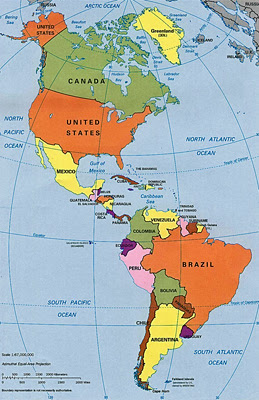
11) Nearly the entire continent of South America is located east of Florida. Without looking at a map, you might assume Brazil is located somewhere directly south of Florida. However, almost the entire South American continent is east of Florida.

12) Sharks predate trees. Archaeopteris, the earliest species that scientists can classify as a tree, lived about 350 million years ago. Sharks can be traced back 50 million years earlier than that, appearing in the fossil record 400 million years ago.

13) Cleopatra lived closer in time to the release of the first iPhone than she did to the building of the pyramids of Giza. The pyramids of Giza were built between 2550 B.C. and 2490 B.C., according to estimates. About 2,421 years later, in 69 B.C., Cleopatra was born. She died at the age of 39 in 30 B.C. Apple co-founder and CEO Steve Jobs debuted the first iPhone in 2007, only 2037 years after Cleopatra's death.

14) Anne Frank, Martin Luther King Jr., and Barbara Walters were all born in the same year. Anne Frank was born June 12, 1929. Martin Luther King Jr. was born January 15, 1929. And Barbara Walters was born September 25, 1929.

Saturday, July 2, 2022

WHO WAS RASPUTIN?

As a follow-up to last week's blog about The Last Czar, Nicholas II and Alexandra of Russia, this week my blog features the mystical advisor who many feel played a pivotal role in the fall of the Romanov dynasty and the advent of the Russian Revolution. Rasputin, born in 1869 and assassinated in 1916, was known as The Mad Monk.

Born to a Siberian peasant family around 1869, Grigori Rasputin received little schooling and probably never learned to read or write. In his early years, some people of his village said he possessed supernatural powers, while others cited examples of extreme cruelty.

His early life was ordinary for the time and place but changed 1892 when he spent months in a monastery although never took holy orders to become a monk. He left the monastery at age nineteen presumably to get married. He had five children although two died shortly after birth. Grigori Rasputin left his family and traveled to Greece and the Middle East, making several pilgrimages to the Holy Land.

In 1903, Rasputin's wanderings brought him to St. Petersburg, where he arrived with a reputation as a mystic and faith healer. Two years later, he was introduced to Russian Czar Nicholas II and his wife, Alexandra Feodorovna, who were seeking help for their sickly son, Alexis. Rasputin quickly gained their confidence by seemingly curing the boy of hemophilia. This action won him the passionate support of Alexandra.

Between 1906 and 1914, various politicians and journalists used Rasputin's association with the imperial family to undermine the dynasty's credibility and push for revolution. Rasputin helped their cause by claiming to be the Czarina's advisor. Accounts of his lewd behavior emerged in the press, solidifying contempt among state officials. In truth, Rasputin's influence at this time was limited to the health of Alexis.

As Russia entered World War I, Rasputin predicted that calamity would befall the country. Nicholas II took command of the Russian Army in 1915, and Alexandra took responsibility for domestic policy. Always Rasputin's defender, she dismissed ministers who were said to be suspicious of the mad monk. Government officials tried to warn her of Rasputin's undue influence, but she continued to defend him, giving the impression that Rasputin was her closest advisor.

On the night of December 29, 1916, a group of conspirators, including the czar's first cousin, Grand Duke Dmitri Pavlovich, and Prince Felix Yusupov, invited Rasputin to Yusupov's palace and fed him wine and cakes laced with cyanide. Though Rasputin eventually became rather drunk, the poison seemed to have no effect. This was refuted by a relative of Rasputin who said he didn't like sweets and wouldn't have eaten the cakes. Baffled but not deterred, the conspirators finally shot Rasputin multiple times. He was then wrapped in a carpet and thrown into the Neva River, where his body was discovered three days later.

His death was officially listed as December 30, 1916 (December 17th on the Russian calendar in use at the time). Not only did he survive the initial poisoning, it was noted that water was found in his lungs indicating he also survived the shooting and actually died by drowning.

Although Rasputin was gone, the last of his prophecies still lingered. Shortly before his death, he told Nicholas that if he were killed by government officials, the entire imperial family would be killed by the Russian people. His prophecy came true fifteen months later, when the czar, his wife and all of their children were murdered by assassins during the Russian Revolution.

Saturday, June 25, 2022

The Last Czar

On July 17, 1918, the last Czar of Russia Nicholas II, his wife Alexandra, and their five children were brutally murdered by revolutionaries known as the Bolsheviks. Though the Bolsheviks claimed to have murdered the entire family, their bodies were mutilated and subsequently buried in unmarked graves which led to speculation that the youngest daughter of the five Romanov children, Anastasia, had escaped.

The rumors seemed all but confirmed when just a few years later a mysterious woman appeared in Berlin and was admitted to a psychiatric facility. The legend of the escaped Grand Duchess and the notion that the mysterious woman could be none other than Anastasia swirled across Europe and continued well into the 1980s. But were the rumors true?

The Bolsheviks, whose revolution would eventually create the ruling communist party in Russia, sent the Romanov family to live in exile in a small house in the city of Yekaterinburg. For 78 days the family was held in five small rooms under constant surveillance as their captors grew increasingly paranoid about a possible rescue attempt.

On the morning of July 17th, the family was ushered into the basement where a bloodbath ensued. Overall, the executions had taken 20 minutes. The bodies were then stripped, burned by fire or in acid, and buried in an abandoned mineshaft. The family’s burial site remained hidden for 61 years following their execution. During this time, the anonymity of their burials and the knowledge that the children had jewels hidden in their clothing, led some to believe that a child could have escaped. Rumors spread and several impostors attempted to claim the royal fortune.

Perhaps the most famous impostor of Anastasia Romanov was an unstable young woman named Anna Anderson. In 1920, Anna attempted suicide by jumping off a bridge in Berlin. She survived and was brought to an asylum without any paperwork or identification.

For six months she refused to identify herself and didn’t speak a word to the hospital staff. When she eventually did speak, it was determined that she had a Russian accent. Combined with the distinct scars on her body and her withdrawn demeanor, this inspired theories among the hospital staff and the patients.

At least four other women would come forward all claiming to be the missing Grand Duchess Anastasia Romanov. These women appeared in different corners of the world at varying times: one appeared in Russia in 1920, another in Chicago in 1963. But none were more famous or had a more believable case, than Anna Anderson.

When Anderson eventually left the hospital in Berlin, she was accosted by the press in an attempt to confirm whether or not she was the Grand Duchess. Since the fall of the Romanov dynasty, Russian aristocrats who were able to escape the Bolshevik takeover had spread all across Europe along with the rumors of Anastasia’s resurrection. Anderson was able to find housing with various aristocrats who had been friends to the Romanov family despite the fact that Anastasia’s former nursemaid, tutor, and many other former servants denied that she was the Grand Duchess.

In 1970, a judge ruled in court that there was not sufficient evidence to prove that Anderson was the Grand Duchess Anastasia. Anderson was eventually identified as Franziska Schanzkowska, a Polish factory worker who had gone missing shortly before Anderson turned up in Berlin. She died in 1984.

The burial site of the Romanovs was discovered in 1979, but this information wasn’t made public until 1991 because two bodies were still missing. One of the missing bodies was Alexei and the other was Maria, one of the Czar’s four daughters. But because the corpses were so damaged, the notion that the missing daughter could be Anastasia persisted.

That was until 2007 with the discovery of two more remains near the site. Their DNA showed that they were the bodies of Alexei and Maria with Anastasia having been identified among the bodies from the previous burial.

I came across a news article…actually, it was a few of years ago…about the Russian government's desire to reunite the remains of their last imperial family in one place—the czar, czarina, and their five children. However, the mission was not without roadblocks, namely the need to satisfy skeptics about the validity of all the remains.

On September 23, 2015, Russian investigators exhumed the body of Czar Nicholas Romanov II and his wife, Alexandra, as part of an investigation into the family's death a hundred years ago—in 1918. It's part of the ongoing attempt to confirm that the remains really belong to Nicholas, Alexandra, and their children. Some of the family's remains were tested in the early 1990s (the early days of DNA testing) with the results being that the scientists were pretty confident that it's really them. The remains exhumed at that time included the czar, his wife, three of their children, and several servants. Two of the children, Alexei and Maria, were unaccounted for at that time. But the officials weren't able to convince the Russian Orthodox Church about the authenticity of the remains.

The church officials have not come out with their exact reasons for doubt. There had been some discussion about the Romanov family having been canonized in 2000 which made the remains holy relics which required a different way of treating them. In general, church leaders say they just aren't convinced. The church's approval is important for bringing the family's remains together.

The church did, somewhat reluctantly, allow the family's remains to be interred in the Peter and Paul Cathedral in St. Petersburg where most of Russia's other czars are buried. But the church still had not accepted the family's identities in spite of the fact that several rounds of DNA testing had occurred.

When the remains of Alexei and Maria were subsequently located (their identities confirmed by DNA testing), those remains were left sitting on a shelf because the Russian Orthodox Church balked at the idea of adding them to the family tomb. The church says it believes the family's remains were destroyed and won't change their position until they are 100 percent sure in spite of the DNA confirmation.

In February 2016 the church once again blocked the reuniting of the remains. Currently, the most prevalent explanation is that the church hierarchy wants to avoid the decision because either choice would alienate key factions. Rejecting the bones will anger some Orthodox adherents, particularly those outside Russia, while accepting them will incense a conservative domestic faction that believes the Soviet government somehow faked the original burial at the time and those aren't the real remains of Czar Nicholas II and his family.

And the entire effort remains in limbo. 

Saturday, June 18, 2022

15 Things Americans Do That Are Odd In Foreign Countries

A while back, I came across a list of things American tourists are guilty of doing in foreign countries. Things that we obviously don't give a second thought. Some are merely odd and others are considered offensive.

Expecting American Food To Be Everywhere

When traveling in a foreign country, if you're looking for McDonalds or Starbucks, you won't be disappointed since these chains and many other familiar ones are readily available worldwide. But that doesn't mean you can order your favorite food item. These franchises succeed in foreign countries by accommodating local tastes and customs.

Exposing Your Toes For All To See

In some Middle Eastern and Asian countries, feet are treated as the filthiest part of the body. Americans don't view toes this way, so our lack of foot concern comes off as strange and impolite. In many countries, you're expected to take off your shoes before entering a room and don't point your feet in anyone's direction. In other countries, showing the bottom of your feet is considered very rude.

Dressing Inappropriately

A surefire way to stand out as different when traveling in a foreign country is to dress like an American. Shorts, skirts, and short-sleeved shirts might seem like smart choices, especially if you're visiting a place that's hot all year or traveling in summer. Depending on where you go, your exposed skin could be offensive. Not only do these fashion errors make us stand out, they can mark us as tourist targets for scammers and criminals.

Wasting Food And Water

When Americans decided that bigger was better (as they used to say at McDonalds, do you want that super-sized?), we also began wasting resources at a dangerous rate. All-you-can-eat buffets, huge food portions, and needlessly leaving water running while brushing our teeth or washing our hands makes us one of the most wasteful countries in the world. Places like France have passed laws making food waste for supermarkets illegal, encouraging businesses to donate it to charity. When in a foreign country, conserve like a local.


Expecting Rush Service

Expecting quick service while in a foreign country is the quickest way to get a double glance from the locals. In the U.S., our tipping culture encourages fast service. In most countries, tradition requires little or no tip. As soon as you complain that you've been waiting too long, don't be surprised if you are ignored completely. [On one of my trips to London, we sat in the lobby of the hotel for three hours hanging on to our luggage because nobody could find a key for our room. The hotel manager apologized by saying, "I know things happen quickly in the States…" After another hour, I finally insisted that someone use a passkey and let us in the room so we could deposit our luggage. It was the next day before they could produce a key for us. The hotel had actual keys rather than the electronic key cards that the registration clerk swipes and assigns to a specific room when you check in.]

Wearing Fanny Packs

If you don't like the idea of wearing a money belt because you think it's too touristy, then just wait until you decide on a fanny pack in another country. They are far out of fashion's reach and visually mark you as an easy target.

Putting Ice In Everything

Ice is an automatic part of American life. We want it in every cold drink. We fill ice chests with it to go to the beach or camping. We even changed the design of freezers to produce more ice quicker. If you weren't born in the U.S., you probably don't understand our fascination with ice. If you're from the U.S. and are traveling in a foreign country, back off of the ice requests. [At a pub in England, ice was available in a small ice bucket like one you would have in your house. It was located at the end of the bar with a tablespoon rather than a scoop which allowed the customer to get ice cubes one at a time from a small supply. If you requested ice in your drink, the bartender pointed to that ice bucket. This was a small neighborhood pub, not the bar in a major hotel or a restaurant.]

Giving Rude Hand Gestures

Americans tend to communicate with our hands, some more than others. Even automatic things like offering a hand shake when meeting someone or giving a thumbs up or an ok sign can be misinterpreted when done in a foreign country. And in China, pointing is very rude.

Using Your Left Hand

Middle Eastern, Indian, Asian, and African countries all have one thing in common—they expect food to be eaten with the right hand only. Common practice for those of us who are right-handed. But for you left-handers, they consider the left hand unclean.

Not learning Local Phrases

In case those born in the U.S. don't realize it, English is one of the most difficult languages to learn. That's why it's particularly hypocritical when we travel in foreign countries that we expect the locals to know at least a few English phrases. Showing cultural respect can be as simple as memorizing a greeting and a couple of basic questions. Americans expect everyone coming to our country to speak English. On the other hand, when we travel to foreign countries, we expect them to accommodate us by speaking English. Very rude, indeed.

Showing Bad Table Manners

Just because we use knives, forks, and spoons doesn't mean other countries do, too. It's ok to use utensils if available, but you should know what is and isn't considered rude at the dinner table. Bad manners—eating anything with your hands in Chile, using a fork to shovel food in your mouth in Korea, putting used chopsticks on your empty plate when you've finished eating in Japan.

Requesting Menu Changes

In the U.S., no one would give a second though if someone requested more salt or pepper in a restaurant, in fact, salt and pepper shakers are common as part of the table setting. In Europe, this might insult the chef since it changes the way he prepared the food. And don't ask for a 'doggy bag' for your leftovers. They might think you intend to feed their food to your dog rather than finishing your meal in the restaurant.

Smiling At Strangers

Maybe we're wanting to show off our expensive dental work or just want to be polite. Whatever the reason, Americans smile too much, especially at strangers when we make eye contact. In some foreign countries, that could get you a nasty look in return.

Talking Too Loudly

The U.S. is an expressive culture. Freedom in America means you can usually be as loud as you want, mostly wherever you want. But when U.S. citizens travel to foreign countries, we attract attention by raising the volume of our voices a tad higher than everyone else in the room. Make sure you aren't the annoying tourist who won't pipe down.

And finally, there's…

Writing Dates Backward

Unlike many places in the world, we don't use metric measurements, our spelling system makes no sense to anyone else (even in the U.K. where English began), and our date format when written as numbers is out of order. While most countries use the DD/MM/YYYY format, we've stepped outside the box since July 4, 1776. We write the numerical date as MM/DD/YYYY. When you travel, be aware that 07/04/2022 is the 7th of April 2022 and not the 4th of July.

Saturday, June 11, 2022

Travel Trivia: 10 Miscellaneous Facts From Around The World

Now that people are starting to travel again, last week I blogged about quirky questions tourists ask.  This week I have some travel trivia for you. I came across an article that listed bits of trivia about various travel destinations.  Little snippets of miscellaneous information usually not included in travel guides.  Things I found interesting.  I hope you find them interesting, too.

1)  Mt. Everest

It's a commonly known fact that Mt. Everest, on the Nepal–Tibet border, is the highest point on earth.  You'd think that would be enough, wouldn't you?  Well, apparently it isn't.  The precise height of Mt. Everest is somewhat disputed.  It's generally thought to be 29,029ft (8848m) above sea level.  And that interesting little fact?  It's still growing!  Mt. Everest is pushing upward at a rate estimated to be 4mm a year thanks to the clash between two tectonic plates.

2)  Mexico City

While Mt. Everest is growing, the interesting little fact about Mexico City is that it's sinking at an average rate of 10cm a year which is 10 times faster than the sinking rate of Venice, Italy.  And the reason for this?  Mexico City was built on a soft lake bed and subterranean water reserves have subsequently been pumped out from beneath the city.  The result?  The city is sinking.  In fact, I saw a news story a while back about a large new sinkhole that appeared in central Mexico and is growing.

3)  Vatican City

The world's smallest independent state, 44 hectares (110 acres) is totally encircled by Rome.  The Vatican's Swiss Guard still wears the uniform inspired by Renaissance painter Raphael.  Its population is 800 with only 450 of those being citizens.  It even has its own coins which are legal tender throughout Italy and the EU.

4)  El Pueblo de Nuestra Senora la Reina de Los Angeles

What is all that?  In English it's Town of Our Lady the Queen of the Angels.  It's the shortened version that's better known today—the city of Los Angeles in the U.S. state of California.  The town came into being in 1781 and today, in an area of downtown Los Angeles referred to as Olvera Street, there is a cluster of museums, ancient plazas and lively markets providing a taste of life in 1800s Los Angeles.

5)  Nuestra Senora Santa Maria del Buen Aire

What is all that?  In English it's Our Lady St. Mary of the Good Air, better known today as the city of Buenos Aires in Argentina.  It's the best spot to savor the tango.  Don't take the tango lightly in Buenos Aires.  It's serious business.

6)  London Underground

London's Metropolitan Railway was the world's first subway, opened in 1863.  The first section ran between Paddington and Farringdon and was a hit in spite of the steam engines filling stations and tunnels with dense smoke.  Today, if you ride the Circle Line between Paddington and Covent Garden, you'll travel part of that original route.

 7)  Venice, Italy

As mentioned earlier, Venice is sinking.  But in the interim…one of the things immediately associated with Venice are the gondolas on the canals, especially the Grand Canal.  Each gondola is made from 280 pieces of 8 different types of wood.  The left side is larger than the right side by 24cm.  The parts of a gondola represent bits of the city—the front echoes its 6 districts, the back is Giudecca Island, and the lunette is the Rialto Bridge.

8)  Great Wall of China

Most everyone knows this is the largest military construction on earth.  However the part about it being the only man-made structure able to be seen from space is an urban myth.  The sections were built by independent kingdoms between the 7th and 4th centuries BC, then unified under China's first Emperor Qin Shi Huang around 210 BC.  A not well known fact is that the sections near Beijing which are most visited by tourists are reconstructions done in the 14th to 17th centuries AD.

9)  Table Mountain, South Africa

This large plateau of sandstone looms over Cape Town.  But this huge table has its own table cloth.  The plateau's cloud cover gathers across the flat top and spills over the sides when the wind whips up from the southeast.  You can reach the top by hiking trails or cable car.

10)  Uluru, Australia

This is probably the world's largest monolith, rising from the Australian desert.  More commonly known for years as Ayers Rock, it is now referred to by the Aboriginal name of Uluru.  The rock glows a fiery orange-red color, especially at sunset.  Where does its red color come from?  It's made from arkosic sandstone which contains iron.  When exposed to oxidation, the iron rusts thus providing the red color.

Saturday, June 4, 2022

Quirky Questions Tourists Ask

We're at the start of the summer tourist season (in the Northern Hemisphere). After the last two years of pandemic stay-at-home, people are wanting to get out. Some of us will be tourists and some of us will encounter tourists. And tourists invariably ask questions.

At one time or another when we were in school, we've probably all heard a teacher say that there is no such thing as a stupid question in an attempt to get us to express our curiosity about something without being embarrassed.

However, as an adult that old adage doesn't apply to all situations.  The travel industry is filled with weird, quirky, and in some cases just plain stupid questions asked by tourists.  Here's a sampling of some from various sources.


Actual Questions Asked On Cruise Ships:

Does the crew sleep on board?

Is the island surrounded by water?

What happens to the ice sculptures after they melt?

What time is the 2 o'clock tour?

Can you see the equator from the deck?

I know that ships often serve smoked salmon, but I am a non-smoker.

Can the iced tea be served hot?

Will I get wet if I go snorkeling?

Should I put my luggage outside the cabin before or after I go to sleep?

Does the outside cabin mean it's outside the ship?

Where is the good shopping in Antarctica?

And cruise ships aren't the only place that tourists seem to have absurd questions.  Here are some actual questions received by Australians from foreigners, along with some well-deserved replies.

Q: Does it ever get windy in Australia? I have never seen it rain on TV, how do the plants grow? (question from the UK)

A:  We import all plants fully grown and then just sit around watching them die.

Q:  Will I be able to see kangaroos in the street? (question from USA)

A:  Depends how much you've been drinking.

Q:  I want to walk from Perth to Sydney—can I follow the railroad tracks? (question from Sweden)

A:  Sure, it's only 3000 miles, take lots of water.

Q:  Are there any ATMs (cash machines) in Australia? Can you send me a list of them in Brisbane, Cairns, Townsville and Hervey Bay? (question from the UK)

A:  What did your last slave die of?

Q:  Can you give me some information about hippo racing in Australia? (question from USA)

A:  A-fri-ca is the big triangle shaped continent south of Europe.  Aus-tra-lia is the big island in the middle of the Pacific which does not…oh forget it.  Sure, the hippo racing is every Tuesday night at Kings Cross.  Come naked.

Q:  Which direction is north in Australia? (question from USA)

A:  Face south and then turn 180 degrees.  Contact us when you get here and we'll send the rest of the directions.

Q:  Can I wear high heels in Australia? (question from the UK)

A:  You're a British politician, right?

Q:  Are there supermarkets in Sydney and is milk available all year round? (question from Germany)

A:  No, we are a peaceful civilization of vegan hunter/gatherers.  Milk is illegal.

Q:  Can you tell me the regions in Tasmania where the female population is smaller than the male population? (question from Italy)

A:  Yes, gay nightclubs.

Q:  Do you celebrate Christmas in Australia? (question from France)

A:  Only at Christmas.

The Daily Telegraph in the United Kingdom put together an international list "of the most inexplicably simple queries fielded by tourism officials."

Are there any lakes in the Lake District?

Why on earth did they build Windsor Castle on the flight path for Heathrow?

Is Wales closed during the winter?

Why did they build so many ruined castles and abbeys in England?

Do you know of any undiscovered ruins?

And here are some tourist questions asked at Niagara Falls:

What time do the falls shut off?

How far into Canada do I have to go before we have to drive on the other side of the road?

How much does it cost to get into Canada and are children a different price?

And here are some goodies from Minnesota:

I'm coming in July and want snowmobile rental information.

We want to tour the Edmund Fitzgerald. (the ship sank in Lake Superior during a storm in 1975)

One traveler asked to see the bridge in Minnesota with the arches.  She was shown various photos, none of which were the bridge she was looking for.  She finally identified a picture of the St. Louis Gateway Arch as the bridge she wanted to see.  She was given directions to Missouri.

And finally…these tidbits.

One tourist to Scotland asked what time they fed the Loch Ness Monster.  Another visitor to New York City thought they would end up in Holland if they drove through the Holland Tunnel.  A traveler in Miami asked a tourism official which beach was closest to the ocean.

So…I guess the bottom line is to maybe think about that question a second time before you actually ask it.   :)